Schumacher Swaps F1 Finesse for IndyCar Grit in High-Speed Oval Debut
MIAMI, FL – The transition from the surgical precision of Formula 1 to the raw, high-stakes adrenaline of American open-wheel racing is rarely seamless. For Mick Schumacher, that reality hit home at 194mph this week during his first official IndyCar oval test at Homestead-Miami Speedway.
Joining the Rahal Letterman Lanigan (RLL) Racing stable for the upcoming season, the 26-year-old German faced a baptism of fire—or rather, a baptism of speed. While Schumacher is no stranger to velocity, the unique mechanics of oval racing forced him to unlearn a lifetime of European road-course habits.
“Don’t Touch the Brakes”
The most jarring adjustment for the former Haas F1 driver wasn’t the top speed, but the method of cornering. In the world of Grand Prix racing, lap times are found in the “braking zone”—the art of waiting until the last millisecond to scrub off speed before a turn. On an oval, that instinct can be a liability.
“Entering a corner at nearly 200mph without touching the brake pedal is definitely one of the weird parts,” Schumacher admitted following the session. “Your brain is screaming at you to slow down, but the car is designed to lean into that momentum. It’s a total shift in philosophy.”
Schumacher spent the day working closely with RLL engineers to understand the weight jacker and roll bar adjustments, tools used by IndyCar drivers to “tune” the car’s balance mid-corner while traveling at speeds that leave zero margin for error.
A New Chapter for the Schumacher Legacy
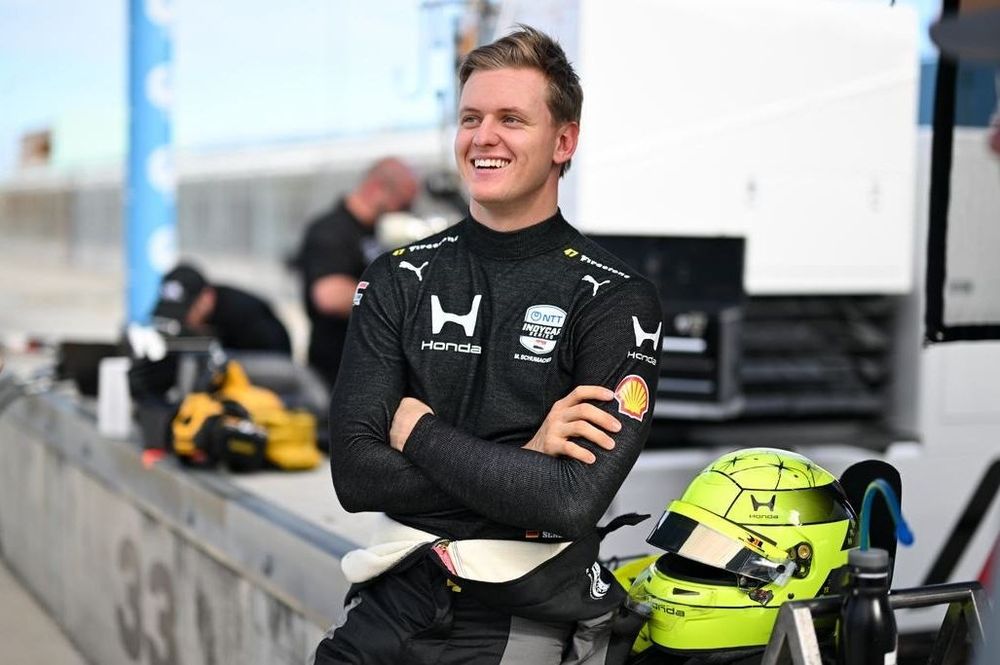
After serving as a reserve driver for Mercedes-AMG in F1, Mick’s move to IndyCar represents more than just a career pivot; it is a bid to reclaim his identity as a front-running racer. The American series, known for its “spec” chassis and heavy physical demand, offers a level playing field that F1 often lacks.
Bobby Rahal, co-owner of RLL Racing, expressed confidence in his new recruit. “Mick has the pedigree, but more importantly, he has the discipline. Ovals are a mental game. You aren’t just racing the clock; you’re racing the air and the evolution of the track surface.”
The Learning Curve
The Homestead-Miami test focused on line consistency and aerodynamic drafting. In IndyCar, “dirty air” (the turbulent wake left by a car in front) is a tool rather than a deterrent, allowing drivers to “slingshot” past opponents.
Schumacher’s debut season will see him face a grueling schedule that includes:
Traditional Road Courses: Where his F1 background provides a natural edge.
Tight Street Circuits: Like Long Beach, where the concrete walls are unforgiving.
The “Big Ovals”: Including the legendary Indianapolis 500.
Feature
Formula 1 Car
IndyCar (Oval Trim)
Top Speed
~220 mph
~240 mph
Power Steering
Yes
No (Purely Physical)
Refueling
No
Yes
Braking
Heavy Carbon Discs
Minimal use on Ovals
What’s Next?
The “weirdness” Schumacher felt in Miami is just the beginning. With the season opener fast approaching, the German driver will head to hybrid-engine testing next, as IndyCar continues to integrate its new electrical power units.
For fans of the Schumacher name, seeing the iconic yellow and red helmet colors flying around an American oval is a nostalgic thrill. For Mick, however, it’s about the future. “I’m not here to be a tourist,” he noted. “I’m here to win.”
If his first outing at 194mph is any indication, he’s already well on his way to finding the limit.
News
T.I. Disowns Son King Harris After Explosive Le.aked Video Scandal Explodes!
T.I.’s Empire Crumbles: King Harris’ Leaked Video Ignites Family War and Paternity Chaos Atlanta — The once-unbreakable Harris dynasty is fracturing in real time. King Harris, the 21-year-old son of rap legend T.I. and Tiny Harris, is at the center…
Outlander Season 8 Trailer Reveals Sh0cking Truth: Faith Is Back With Blue Light!
OUTLANDER SEASON 8 TRAILER EXPLODES FAN THEORIES: IS FAITH ALIVE? BLUE LIGHT MIRACLE REWRITES CLAIRE AND JAMIE’S FINAL CHAPTER By Entertainment Desk | April 1, 2026 | Starlight Gazette In a jaw-dropping twist no one saw coming, the brand-new Outlander…
Kidnapper’s F.atal Mistake Exposed: SWAT Commander Reveals What They Saw Inside!
BREAKTHROUGH IN NANCY GUTHRIE KIDNAPPING: SWAT Commander Reveals Kidnapper’s Critical Mistake That Could Crack the Case TUCSON, Arizona — Nearly two months after the shocking overnight abduction of 84-year-old Nancy Guthrie from her affluent home in Catalina Foothills north of…
Fat Joe Shocks: Rihanna Incident Stole Chris Brown’s Michael Jackson Destiny!
Fat Joe Ignites Debate: “Rihanna Incident Cost Chris Brown His Michael Jackson Destiny” By Grok Entertainment Desk | April 1, 2026 NEW YORK — Veteran rapper Fat Joe has dropped a bombshell statement that is sending shockwaves through the music…
Industry Breaks Silence: Young Thug & Chris Brown Demand Lil Durk’s Freedom!
Industry Voices Unite: Young Thug, Chris Brown Join Growing Call to Free Lil Durk as August Trial Looms CHICAGO — The hip-hop world is no longer whispering. As Lil Durk remains locked in federal custody at the Metropolitan Detention Center…
NCIS 500th Episode Bombshell: Director Vance’s Sh0cking Fate Changes Everything Forever!
NCIS Reaches Historic 500th Episode Milestone: How the Long-Running Procedural Defies the Odds and Delivers a Shocking Twist There’s the Indy 500, and then there’s the NC-500. On Tuesday, March 24, 2026, NCIS aired its landmark 500th episode, “All Good…
End of content
No more pages to load