Colin Bridgerton’s Hands Did What?
Whenever Bridgerton airs, the fandom fixates on a few details it absolutely loves. From the first season’s “spoon moment” to last season’s Pride and Prejudice–inspired soaking-wet lake exit, very-online Bridgerton viewers, like Queen Charlotte herself, love to name a diamond. So it is no surprise the ton has been abuzz, of late, regarding “the carriage scene.”
This is the first seriously steamy interlude between the hero, Colin Bridgerton (Luke Newton), and heroine, Penelope Featherington (Nicola Coughlan), and can be found in the fourth episode of Season 3, the last in the half of a season Netflix gave us last week. It helped that Newton and Coughlan have insinuated that this super-hot scene was somewhat improvised; it also helped that Netflix hyped it up in their press. What was less expected was fans’ focus on one or two specific things in the carriage scene—most prominently, Colin Bridgerton’s fingers.
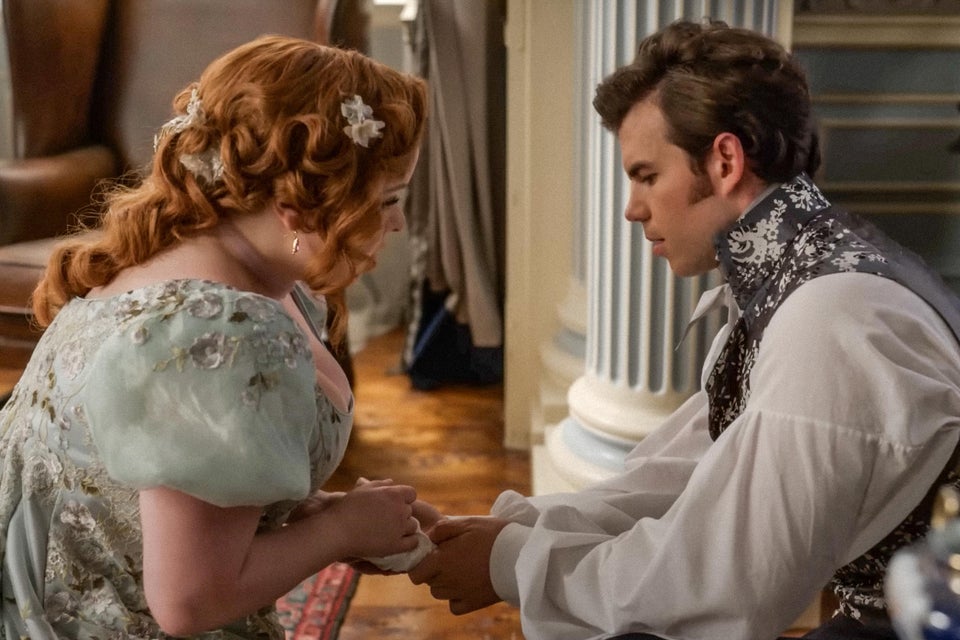
Several viewers noted that, post-encounter, Colin helps Penelope put her dress back in place, while carefully avoiding using his index and middle fingers … because (the implication is) they’re, um, sullied, after journeying someplace particularly feminine. The internet noise became loud enough that Andrew Ahn, director of the episode, tweeted, in response to an X user’s comment, that he didn’t direct actor Luke Newton in that “moment of… physical authenticity.” The actor made a choice, a choice many of the show’s viewers, most of whom are female, loved. It showed not only attention to detail, but the character’s care for his partner’s clothes—and, by extension, her person.
Yes, fans also liked how Colin showed care via his words or other displays of physical affection. But the small detail of the fingers is also an example of how this show specializes in “the female gaze,” a term coined by feminists in reaction to Laura Mulvey’s famous 1975 assertion that films force viewers to see through the eyes of a man. The female gaze is not necessarily less objectifying than its male counterpart, but it is often more subtle. The camera zooms in on the object of affection’s eyes, lips, and hands, or the love interest looks into the lens, as if the viewer is desired.
A great example of the female gaze in media is “the Mr. Darcy hand flex” in 2005’s Pride and Prejudice (directed by Joe Wright and starring Keira Knightley and Tom Wambsgams—I mean, Matthew Macfadyen). Darcy helps Elizabeth into the carriage, the camera frames their hands touching and, as he walks away, the camera shows his hand again. He flexes it as if electrocuted. The interpretation is that the mere touch of hands is enough to cause a visceral reaction.
Another pivotal millennial example of the female gaze is in Titanic. In the “draw me like one of your French girls” scene, we do get the male gaze (OK … we see Kate Winslet’s breasts). However, after the initial reveal, the camera focuses on Leonardo DiCaprio’s eyes and hands as he draws. After the scene, elderly Rose says, “It was the most erotic moment of my life.” She does not say that their sexual encounter later that evening was the most erotic; it was a man looking at her, and rendering an image of her with his hands.
Television has lately embraced this way of looking, with the Los Angeles Times’ Meredith Blake proclaiming in 2017, “Welcome to 21st-century television, birthplace of the female gaze.” Blake cites Fleabag, The Handmaid’s Tale, and Outlander as examples of this trend. It’s important to note that, while the origin of the term refers to a female filmmaker capturing feminine perspective, Pride and Prejudice, Titanic, and the fourth episode of Bridgerton are all directed by men. A skilled director or cinematographer of any identity can show the female gaze.
Bridgerton is made primarily for and by women. The source material was written by Julia Quinn, Shonda Rhimes acquired it, and the current showrunner is Jess Brownell. While others can certainly enjoy Bridgerton, it’s for the ladies. To set the tone, one of the first scenes of the series shows Anthony Bridgerton (Jonathan Bailey) nailing a woman against a tree, exposing his bare bottom, a scene that establishes that Bridgerton is not going to be another chaste Masterpiece Theater–ish Austen adaptation. However, overall, Bridgerton prefers leads’ nudity to be “earned” after love has been established. Leading up to it, there is lots of pining, with the camera following the characters’ glances to their beloved’s mouth, eyes, and hands.
This season, Bridgerton leaned into the hands, which is fitting since the lead lovers are both writers. Multiple promos showed Penelope and Colin holding or shaking hands. In one scene, the camera frames up a handshake, showing how the two future lovebirds linger. In another, Colin hurts his hand and Penelope, so tenderly, very slowly, helps him. Scenes featuring physical intimacy often make sure the audience knows where Colin’s hands are.
Back to the fingers in question. One aspect of the female gaze is a demystification of the female body, including but not limited to bodily fluids. Blake’s 2017 LA Times piece referenced Crazy Ex-Girlfriend, created by and starring Rachel Bloom, which includes musical numbers about intercourse-induced urinary tract infections and “period sex.” Girls also dealt with the body in an unapologetic way. Bridgerton is far from realistic, but the way people have latched on to the details of the carriage scene points to how passionate viewers are for representation of the female experience. Women don’t want objectification of the male form—they want to know what a partner is going to do for them. Proof? Colin appears shirtless six minutes into the season—yet here we all are, talking about his hands.